
Compound versus Brand GLP-1 Weight Loss in Miami: Which is Right for You?
by Dr. Richard Lipman, M.D. Board Certified Internal Medicine/Endocrinology
Reviewed and Updated March 15th, 2026.
Compound Semaglutides and Tirzepatides in Miami offer the same weight-loss results as their brand counterparts—Ozempic, Wegovy, Mounjaro, and Zepbound—at 50-75% of the cost, making them a cost-effective option for patients seeking effective treatment.
These versions of GlP-1 medications fall into two groups:
- Compound drugs: the Semaglutide compounds and the Trizepatide compounds.
- Brand drugs: The brand versions of GLP-1’s consist of 2 medications each: Semaglutide brands are Qsymia and Wegovy, and Trizepatide brands are Mounjaro and Zepbound.
Side effects and safety are similar between the two groups of GLP-1 compound drugs and their equivalent brands, with weight loss often higher with Zepbound and Mounjaro versions. Knowing that compounded options have comparable safety profiles can help you feel more comfortable and confident in your choice.
Compounded GLP-1 preparations permit microdosing, allowing your doctor to tailor the medication to your individual needs and tolerances. This personalized approach can help you feel more confident in your treatment plan by reducing side effects and enhancing effectiveness. Proper dosing and timing, including choosing the right syringe size, can further improve results and minimize discomfort.
Compound Semaglutides and Tirzepatides are GLP-1s similar to the brand GLP-1s: Ozempic, Wegovy, Mounjaro, and Zepbound.
Compounded Semaglutides and Tirzepatides are not new drugs but rather custom-made GLP-1 drugs prepared by pharmacies licensed in each state from the original chemicals. They differ in dosage, form (e.g., liquid or powder), or additives (e.g., vitamin B12 or B6).
GLP-1 compounds, whether Semaglutides or Tirzepatides, produce similar weight loss to their originals, often as much as 25 to 30% of the starting body weight. First marketed as Ozempic, this semaglutide has been on the market since 2017 and taken by millions of people with diabetes and obese people all over the world. In addition, they have been carefully evaluated in over 100 studies conducted in the US, South America, Europe, and Japan, with no evidence of significant problems. Aside from mild to moderate gastrointestinal side effects, there are a few other side effects.
What is the Cost of Compounded GLP-1’s vs. Brands in Miami?
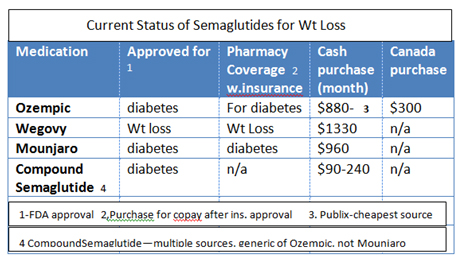
Compounded GLP-1s cost much less than the brand equivalents of Ozempic, Wegovy, Zepbound, and Mounjaro. The latter drugs cost $500 to $1500-$1900 or more per month. The costs of compounded GLP-1s are low because you are not paying for expensive injection pens, extensive manufacturing facilities, distribution networks, or even pharmacies. GLP-1’s compounds are sent directly by the compounding pharmacy to the patient or physician. Typical costs are less than $300/month, with starting doses at about $190/month for four weekly injections. Compound Semaglutide costs depend on dosage (unlike Semaglutide pens, where all doses cost the same), shipping, and any additives. See the table below for costs.
GlP-1 Medications Unprecedented Weight Loss is Due to Action on Receptors All over the Body
Surge in Insulin and Reduction in Glucagon with these Medications’ Action on the Pancreas
GLP-1s, whether Semaglutides or Trizepatides, including compound versions and brands, are derived from the incretin hormones GLP-1 and GIP (in the case of Mounjaro and Zepbound), which are made normally in specific cells in the small intestine. After eating a meal, they trigger a chain reaction by first increasing insulin and lowering glucagon (the hormone that stimulates appetite). The surge in insulin and the reduction in glucagon levels delay gastric emptying, signaling the brain that the stomach is full. Recent evidence indicates effects on the body beyond weight loss and glucose control.
All GLP-1 Medication(whether brand or compound) acts on the Appetite Centers of the Brain, on Muscles, and on the Liver.
In addition, GLP-1’s work by binding to GLP-1 receptors in skeletal muscle, liver, and pancreas, and, most importantly, in the brain’s appetite centers. This reduces cravings, especially for sweet and fatty foods. This helps the individual who wants to lose weight quickly and safely. It’s proven to be a potent, long-lasting appetite suppressor without the complications associated with older, stimulating medications. In addition, the marked improvement in blood sugar makes the semaglutides an excellent choice for overweight diabetics, especially of Hispanic backgrounds. Weight loss is often 25-30% of the starting weight over just a few months. The weight loss with compounds is the result of the following mechanisms:
1. Decrease appetite and craving
2. Increase in satiety and delayed gastric emptying
3. Changes in food preferences- away from fatty foods and carbohydrates
4. Reduced energy intake
Compounded Semaglutides are Different than Mounjaro and Zepbound (Tirzepatide)
Compound Semaglutides (similar to Ozempic and Wegovy) are different from Mounjaro and Zepbound because they include a second hormone, GIP, which makes them more effective.
Compounding Pharmacy: Produce 6 Compound GLP-1 Medications:
Some of the Common Compounded Semaglutide, similar to Ozempic and Wegovy
These are the most common compounded Semaglutides that are based on a single GLP-1 peptide:
1. Semaglutide-Vitamin B 12.
2. Semaglutide-Vitamin B 6,
3. Semaglutide-L Carnitine
4. Semaglutide -2.
5, Semaglutide-NAD+.
Similar combinations are seen in the Tirzepatide combinations, which are equivalent to the Zepbound and Mounjaro brands. The L-carnitine version is the most common in South Florida, especially in Homestead and Cutler Ridge, Florida.
The combinations of Vitamin B12 and L-Carnitine are the most popular. I have treated individuals with both of these preparations. My limited experience shows little difference in weight loss. The Vitamin B12 preparation has slightly fewer GI side effects.
Compounded Tirzepatide -Compounded version of Mounjaro
This is a compounded formulation containing both GLP-1 and GIP agonist peptides, similar to Mounjaro and Zepbound. This is the most effective among the compound GLP-1s because it has both GLP-1 and GIP activity. The compound Zepbound is reserved for overweight people, while the compound version of Mounjaro is usually used for diabetics. We have found that the compounded versions of semaglutide are very effective for Hispanic diabetics in Miami.area including Hialeah, Homestead.Cutler Bay.
Why Substitute Compounded Semaglutides for Ozempic, Wegovy, or Zepbound and Mounjaro? ….. It’s the Cost, Availability, and Reduction in Side Effects.
Ozempic, Wegovy, and Mounjaro — the brand-name GlP-1 medications — are very expensive.
Semaglutide Brands are costly medications. Ozempic, on the market for 6 years, costs $1070/month, while Wegovy, one of the most recent options, may cost as much as $1619/month. Mounjaro falls in between at about $ 1,174/month, and Zepbound can be lower. Unfortunately, weight loss is dose-dependent; the higher the dose, the greater the weight loss. The most significant weight loss with Ozempic, Wegovy, and the Compounded semaglutides occurs at doses of 2.4 mg per week. For Mounjaro and Zepbound, the most significant weight loss is at the 15 mg dose per week. This becomes expensive if it’s needed for months. Insurance covers only a minority of obese people (it depends solely on their contract, not on their weight). Ozempic is more easily covered, but only for uncontrolled diabetics. Table 1 shows. Semaglutides, both compounded and brand, and their discounted monthly price
Table 1: Current Prices of Brands and Compond GLP-1’s
Compounded GLP-1 Drugs are Less Expensive than Brand Products
Compounded GLP-1 costs less than the Brand equivalent. The cost varies and depends on the compounding pharmacy, the specific preparation, the dosage, and even shipping charges. Unlike the brand Semaglutide GLP-1s, the cost depends on the amount of medication. In addition, most individuals purchase their Brand Semaglutides from a local pharmacy and do not pay shipping costs. Compounded Semaglutides are usually purchased online, and shipping charges can be expensive because the medications must be kept cold and shipped in thermal containers. Shipping charges can vary from $45 to $75 per order.
The Brand GLP1s Ozempic/Wegovy, Zepbound, and Mounjaro are sold in 4 Pre-Filled Pens in a box by the Month: Preparations Have Fixed Monthly Doses that cannot Be Individualized.
GLP-1’s are sold in pre-filled, pre-dosed pens that are used once and discarded. All of them are sold by the month with four pens per box. While this is very convenient, it increases costs and reduces efficiency. The patient purchases a box of 4 pens for the month and cannot change the dosage of the pre-filled pen once it has been purchased. This means the patient may end up taking too much or too little medication over the 4-week injection period. Here is the Mounjaro pen. Other than locking and unlocking the injection mechanism, there is no control over dosage—it’s all or none… and it’s all or none for a whole month!
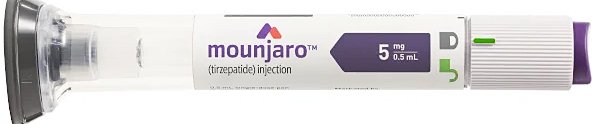
Mounjaro auto-inject pen.
GLP-1 Compound Pharmacy Prepares in Bulk and Has Variable Doses that can be Individualized over the Month:
Unlike the brand semaglutides, the compounding pharmacy ships the medication in a multiple-dose vial. Insulin syringes are used to obtain the medication from the bottle and inject the drug, permitting individualization of each dose throughout the month. This accelerates weight loss and reduces side effects, since the dose can be adjusted each week.

Compounded GLP-1 can be combined with other Medications to Increase Weight Loss and decrease side Effects at the time of Injection.
Unlike the fixed dose of the brand Semaglutides, other medications can be combined into the injection that may increase weight loss and even reduce side effects. This is reviewed under the ‘compound preparations’ section.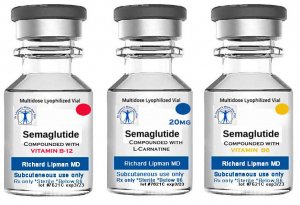
Compound GLP-1 Use for Weight Loss: Comparison with Ozempic/Wegovy/Zepbound & Mounjaro
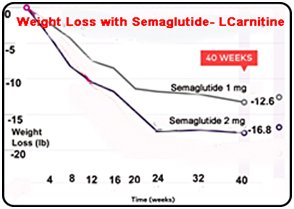
Compound GLP-1 Weight Loss varies depending on the individual’s starting weight, age, and gender. Weight loss usually begins with the 0.5 mg/week injection and increases with increasing doses. Here is a graph with 1 mg and 2 mg per week doses showing average pounds lost per week on the left axis and % weight loss from baseline on the right axis. Notice that the weight loss at 12 weeks accounted for about 2/3 of the total, and by 24 weeks it was almost equal to that at 40 weeks. The average weight loss from baseline at 40 weeks was 12.6% with 1 mg of Semaglutide/L-Carnitine and 16.8% with 2 mg. Table 2 shows weight loss with 2 doses of compound semaglutide, which is almost
the same as the brand.
Table 2: Weight Loss with Compound GLP-1 Dose Relationship
Compound GLP-1 Dosing is individual for Each Patient
Initial Dosing of Compound GlP-1: Issues to Consider
Compounded Semaglutides have the same starting doses as Ozempic/Wegovy: 0.25 mg or 0.5 mg, with a maximum dose of 2.0 mg/week. Microdosing — starting at 1/3 or 1/2 of the dose — is easy to do and should be considered when a history of gastrointestinal problems is found. Each dose is given as a subcutaneous injection once a week. Depending on the weight loss and the presence of side effects, the subsequent weekly doses can be adjusted upward or downward. This unique dosing of compound semaglutide results in greater weight loss and fewer side effects than those seen with the brand versions. This also reduces costs even more. Weight loss increases as the doses are increased, beginning at 0.5 mg/week in some people and after only 2- 3-4 weeks when the “steady state is achieved. A rate of Many individuals lose significant weight at only 0.5 mg/week. We have split the dose into two equal injections during the same week to reduce side effects.
Below are the initial and treatment doses of the average individual starting Compound Semaglutide treatment. Table 3 shows the initial doses of compound GLP-1s.
The Day of the Week When GLP-1 Is Taken Can Affect the Weight Loss
I have observed in many of my patients faster weight loss when the medication is taken on Thursday and Friday as compared to weekday injections because:
1. Most of the GI side effects of nausea, vomiting, and diarrhea are confined to the weekend, limiting excess eating that often occurs.
2. It prevents loss of the workday due to side effects.
3 The injection is more effective in the first few days, and most people usually eat more on the weekend than on weekdays.
Semaglutide-Ozempic/Wegovy and Mounjaro Previous Use Determines Dosage
Semaglutide dosing and subsequent weight loss are also based on the previous use of any of these medications. Patients who have taken large doses in the past — 10 mg to 15 mg per week of Mounjaro, or 1.5 mg per week or more of Wegovy or Ozempic — should be started on higher doses of the Compound Semaglutides.
Compound GLP-1’s should be Used Carefully in Older Individuals and those with a History of Gastrointestinal Disease.
Older patients or those having a history of gastrointestinal disease should be started on very low doses. Even half doses of the lowest 0.25 mg or 0.125 mg/week can be used. Low doses should be used in patients with a history of GERD, colitis, and gallbladder disease. Although semaglutides have not been shown to cause pancreatitis, people with a previous history of pancreatitis should avoid these medications.
In addition, you should not take these medications if you have a history of diabetic retinopathy, medullary thyroid cancer, or multiple endocrine neoplasia type 2.
Switching Between Compound GLP1s and Brand Semaglutides (Ozempic/Wegovy) and Brand Trizepatides (Mounjaro, Zepbound)
When switching from Ozempic/Wegovy to any of the five compounded Semaglutides, the same doses apply. Zepbound/Mounjaro, however, are slightly different because of the added GIP hormone. Doses of Mounjaro range from 2.5 to 5 mg to 7.5, 10, 12.5, and 15 mg per week. Switching from Zepbound/Mounjaro to Semaglutides is more difficult. I suggest those taking 2.5 or 5 mg of Mounjaro take 0.5 mg of Semaglutide per week. Individuals taking 7.5 or 10 mg of Mounjaro should take 1 to 1.5 mg of Semaglutide per week, and those taking 12-15 mg of Mounjaro should take 1.75 to 2.0 mg of Semaglutide per week.
Compound GLP-1’s and Tirzepatide/Mounjaro Side Effects:
Compound Semaglutides have side effects similar to those of the brand-name drugs Zepbound and Wegovy. In the clinical studies, a few withdrew because of side effects. Most occur early, during the first few days after injection, especially when the dose is escalated. The most common side effects are gastrointestinal, with nausea being the main complaint. Weight loss and side effects with Compounded Semaglutides are no different from those found with the brand version.
Nausea: This is the most common side effect. It usually occurs during the first 1-2 days after the injection. It may be associated with some mild vomiting. Lowering the dose or delaying its escalation often solves this problem. More than 50% of patients have minimal to no nausea. Only about 25% of patients experience significant nausea. Zofran 4 or 8 mg or Compazine suppositories are used.
Vomiting: usually, in the beginning, is often associated with skipping meals and then eating a large meal or eating too fast. You can take Zofran 4 mg or Compazine.
Diarrhea: less common, usually intermittent, possibly caused by changes in food or the effect of semaglutide on the lining of the GI tract. Treat with Imodium if persistent.
Constipation: prevalent and again intermittent, may or may not be related to medications, where there has been a significant reduction in food, especially in fats and oils. Treat with Miralax and Metamucil capsules.
Heartburn: Reflux is prevalent when taking these medications. It’s due to delayed stomach emptying. Treatment with Omeprazole (Prilosec) daily in the morning) Or Pepcid AC at any time, if needed.
Fatigue, lack of energy: this typically occurs when skipping meals, but is significantly increased with these drugs, which are designed to lower blood sugar in people with diabetes. In non-diabetics, there is also a lowering. Semaglutide administration itself in some people produces fatigue and weakness.
Allodynia has been reported in the last several years. It is an effect of all of the GLP drugs on the peripheral nerves when administered subcutaneously. It is characterized by a burning, painful sensation in limited areas of the skin, but no particular rash. It is usually self-limiting. Often, stopping the drug for a few weeks will let the whole problem disappear. Often, switching from one GLP to another will stop the problem as well. I have seen four cases in the last three months with these symptoms. One person discontinued the drug because he was almost finished with the diet plan. Three others switched to different ones, and the symptoms did not recur. Table 3 outlines dosing.
Table 3: GLP-1 Dosing
GLP-1 Weight Loss Dosing Chart
| Brand | /Formulation | /Starting Dose/ | Dose Increase | /Maintenance /Dose | Frequency |
|---|
| Zepbound | Injection | 2.5 mg per week for 4 weeks | After 4 weeks, increase to 5.0 mg/week | 2,.5 mg per week | Weekly injection Wegovy |
| ovy | Injection (Weight Loss) | 0.25 mg per week for 4 weeks | Increase every 4 weeks by 0.25 mg | 2.4 mg per week | Weekly injection |
| Compound Semaglutide | Injection or Oral | Typically follows Zepbound or Wegovy schedules | May vary based on compounding pharmacy | Usually follows branded doses, but can vary | Weekly (for injections) |