
High Protein Bars Boosts GLP-1 Weight Loss by Getting off Slow Downs and Plateaus
In some individuals with IBS-D, protein bars might accentuate the gastric symptoms early in the diet plan. The bars and other foods containing high levels of sugar alcohols should only be used after the patient is accustomed to the plan, and there are no significant gastrointestinal side effects. They are useful late in the afternoon when there is a tendency to low blood sugar reactions, manifested by fatigue, weakness, and no energy.
High Protein/Low Carb Bars Available in Many Versions: No Nuts, No Soy, N0 Splenda
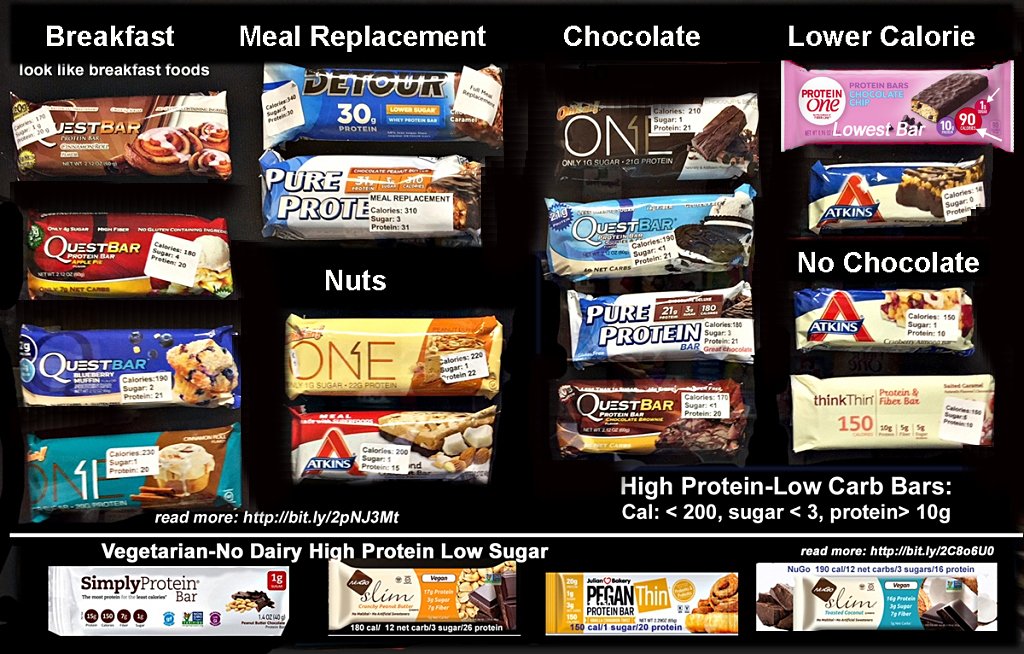
High protein/low carb bars come in many categories. Some look like breakfast foods and are ideal for eating breakfast on the run. Others have higher calories and protein and can be used as meal replacements. Lower-calorie versions serve as quick afternoon snacks. You can buy bars that contain no chocolate, others that mainly contain nuts, and even more that contain no milk products and are ideal for vegetarians. There are bars with no soy products and no artificial sweeteners. Others with Stevia only. Here is a selection of some of them:
High Protein/Low Carb Bars Increase Protein Intake Quickly Decreasing Slowdown and Plateaus
- Pre-measured protein, carbs, and fat
- Extremely Portable –always with you in the car, at work, school or on an airplane
- Easy portion control
- Easy to add minerals and vitamins
- Easy use: no refrigerator, tools needed
- No clean up required
- Less planning and shopping required
- High protein prevents hunger and produces fullness by reducing grehlin(hormone causing hunger) and increasing satiety
- High protein helps prevent loss of lean body mass
- Accurate and easy control of calorie, protein and carb intake
- Prevents hunger in between meals while controlling calories and carbs
- Many bars have high fiber content which promotes fullness and reduce caloric intake
- High protein, high fiber and low carb bars or shakes promote lean muscle mass.
- Helps recovery phase after intense exercise
- Stabilizes Blood sugar through the day
- Improves metabolic health
- IQ Bars offer high protein, low carb, vegan, no soy and gluten free:
Side Effects of High-Protein Bars and Shakes
High protein, low carb bars-what are the side effects? There aren’t any, really. It’s just a chocolate bar with added whey or casein protein powder (or both). There’s also a lot of fiber in some of them. Each bar will contain an average of 20 grams of protein, so even if there were issues with high-protein diets, this would not be an issue. A few people have problems with the sugar alcohols in some of the bars and shakes because of the sugar alcohols, which can cause cramps, gas, and nausea. The newer ones, like most Quest Bars and shakes, use erythritol, which has many fewer side effects. Some people complain of a “chalky ” taste after the bar, others of an after-taste. My suggestion is to simply find a different bar. With more than 1500 different bars, it should not be a problem. Publix supermarkets in Hialeah and Doral have stalked large variety of these bars.
Comparison of Weight Loss: Shakes and Bars vs. Conventional Calorie Counting Diets
High-Protein Bars/Shakes Improve Weight in participants who replaced two out of three meals with lost more weight than the comparison group that chose a self-selected, iso-caloric eating plan using conventional foods. At 3 months, the group consuming meal replacement options and bars lost 7.8% of their initial body weight, whereas the group eating conventional foods lost 1.5% of their initial body weight. The authors reported:
“Our pilot study is the first to demonstrate that subjects consuming low glycemic load, high-protein shakes and snacks coupled with targeted nutraceutical supplementation may show a greater reduction in BMI and fat mass as well as lipid biomarkers and CMS risk than subjects on a more traditional calorie-restricted diet and aerobic exercise plans with or without high-protein, low glycemic load shake formulations.”
The American Diabetes Association (ADA) recommends these meal replacement products once or twice a day to replace usual meals because they produce significant weight loss.
Guidelines to Find the Best Protein Bar/Shake for Weight Loss and Maintenance
There are hundreds of different protein bars and shakes available. How do you find the best bar and which bars should you avoid? There are low and high-calorie bars, high protein, low carb, high carb, low protein, bars with high fiber and numerous other variables. We need strict rules to find the best ones. These “rules” are meant for individuals whose goal is weight loss and weight maintenance:
- Calories: Calories should average about 170 calories. Higher-calorie bars may serve as a meal replacement, but watch the total calories. Bars with more than 300 calories often are not the best choice for most people
- Protein: Protein bars should have at least 10 grams of protein or more; the more, the better. The best bars had 20-25 grams of protein. The Kind Bar at 3 grams to 8 grams of protein is
not desirable for weight loss. Look for at least 10 grams of protein for every 100 calories. - Sugar: Many bars can really be candy bars in disguise. The Cliff Bar and Balance Bars have 21 and 17 grams of sugar. The ideal sugar per bar should be at most 2-3 grams of sugar.
- Fiber: Generally as high as possible.
- Fat: Look for fat less than 12 grams, the higher the fat the more the calories.
Watch the Calories: Some Bars are NOT Low-Calorie
Like all packaged foods, make sure to read the label. Many meal replacement bars are 400+ calories (that’s equivalent to eating one egg, two egg whites, three slices of light toast, strawberries, and a veggie sausage patty)! If you’re eating a bar for a snack, it should be closer to 200 calories or less; for meal replacements, look for bars or shakes that are up to 300 calories. Most of the bars pictured above are 170-190 calories. These can be used as a snack and a meal replacement. All of the bars and nutrition labels can be accessed by on line viewers.
Beware of Certain Ingredients in High-Protein Bars
This is the big one! The first five ingredients (of any label) make up the bulk of the nutrients. If you see these listed as some of the top ingredients, I recommend skipping that bar altogether.
- Soy Protein Isolate & Soy Lecithin: “Seriously processed soy junk…” says Lauren Slayton, MS, RD, author of “The Little Book of Thin”
- High Fructose Corn Syrup & Sucralose: “High-fructose corn syrup is generally a clue that the bar company doesn’t care about high-quality ingredients,” says Slayton
- Sugar alcohols, which show up on labels as erythritol, mannitol, sorbitol, xylitol, lactitol, isomalt, maltitol, and hydrogenated starch hydrolysate
- Inulin: “When consumed in large amounts, it can actually do the opposite of promote healthy digestion—it can give you an upset stomach, diarrhea, gas, bloating, or constipation,” says McKel Hill, MS, RD, creator of Nutrition Stripped
- Soluble Corn Fiber: May result in gastrointestinal effects
High Protein/Low Carb Bars: Watch the Macro Nutrients
Macro-nutrients are those nutritional components of your diet that are needed in relatively large amounts. You need protein, carbohydrates, fat, and macrominerals. It’s a great idea in general to start getting into the habit of reading nutritional labels so you understand what gaps are being filled in your daily macronutrient intake, especially regarding protein. The average person can only absorb 25-30 grams of protein in one sitting; the rest will go to waste.
Things to look for in protein bars:
- Serving size (bars are often two servings)
- Relatively low carbs (under 20g)
- Fiber (soluble is best – 5g)
- Protein, not soy (no more than 30g, 10-15 grams is the minimal )
- Fat (less than 10g)
However, shakes are not as portable as bars. Some need to be mixed almost all need to be consumed cold. The real issue is the degree of fullness. Many dieters feel fuller when they eat rather than drink their calories, even if the protein content is the same. At the end of the day, high-protein, low-carb bars offer easy, portable protein replacement, especially during the most dangerous times. They help keep you full and reduce the temptation to reach for higher-calorie, more dangerous snacks.