



Once Monthly Semaglutide/Tirzepatide: for Weight Maintenance/Miami
by Dr. Richard Lipman M.D. Board Certified Internal Medicine, Endocrinology
Reviewed and Updated March4, 2026
Once-monthly injections of Semaglutide or Tirzepatide for weight maintenance (following weekly treatment with these medications) offer a solution to the common problem of weight regain after initial weight loss. Dr. Lipman’s Weight Maintenance Plan draws on his three years of experience treating over 1,500 overweight patients in his Miami office with Semaglutides, Compound Semaglutides, and, more recently, with Tirzepatides. It addresses the challenge of sustaining weight loss indefinitely with a single monthly injection of Semaglutide or Tirzepatide.
In this second report, Dr. Lipman reveals that 725 of his patients taking compound semaglutides, Ozempic, Zepbound, Mounjaro, or Wegovy lost 20 or more lbs and kept the weight off for 12 or more months. Each patient accomplished this with a single injection of one of these new medications on the first day of each month. Many of the injections were by micodosing small amounts.
Advantages of Dr. Lipman’s Once-a-Month Injection Program:
– Marked cost reduction: Fewer doses are required compared to weekly treatments, making the program more affordable. Patients paying $550 or $1000 per month see their costs reduced to $140 or $250 per month. Patient taking Dr. Lipman’s Semaglutide
compound preparation often pays only $80 per month.
– Improved availability: With fewer doses needed, there is less strain on medication availability. Although injection pens for GLP-1s all cost the same, the lower doses are less popular and much easier to find.
– Better insurance coverage: The reduced frequency of injections may lead to better insurance support for the treatment.
– Reduction in side effects: Monthly administration results in far fewer side effects, improving patient comfort and desire to follow the plan.
– Increased patient compliance: The simplicity of once-a-month injections encourages greater adherence to the treatment plan, leading to better overall outcomes.
Why Do We Regain Our Weight after Weight Loss? ADAPTIVE THERMOGENESIS.
Losing weight is often a complicated process, but for many, the real challenge begins after reaching their goal—maintaining the weight loss. Most people who lose a large amount of weight regain it within 2 to 3 years. This phenomenon, often referred to as weight regain or metabolic adaptation, is common among the majority of people I have treated. The implications of this cycle of weight loss leading to weight gain go beyond just the numbers on the scale; it directly impacts overall health, often leading to the resurgence of chronic conditions like high blood pressure, high cholesterol, sleep apnea, and joint issues such as arthritis in the knees and back that were improved or even eliminated by the initial weight loss.
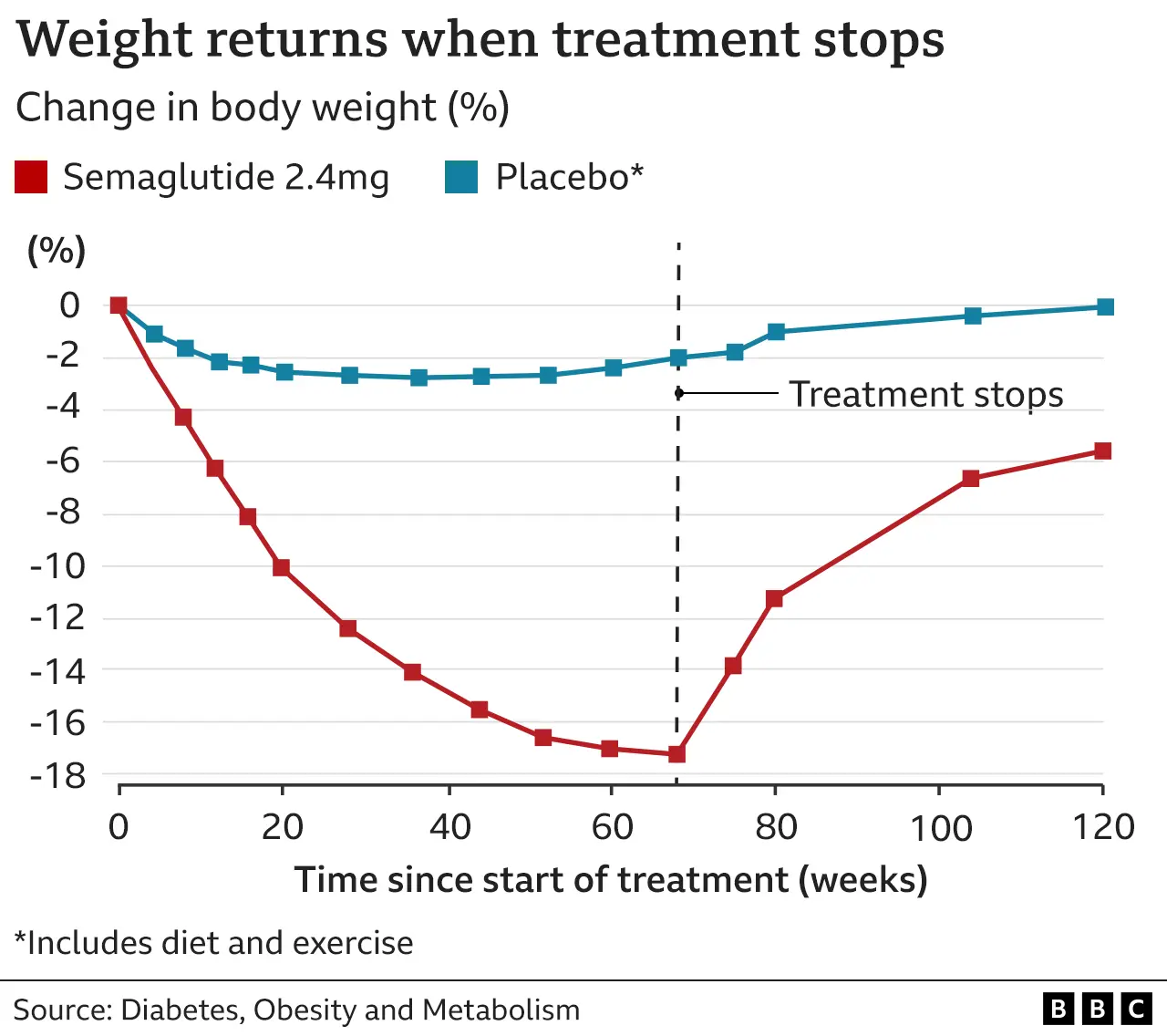
The graphs below show the typical weight regain after weight loss. Graph 1 below shows the weight loss over 14 weeks while eating three different reduced-calorie diets. Note the gradual weight gain after 14 weeks despite the same diet program and the very similar weight loss-weight regain patterns, no matter how the weight loss was obtained. This weight regain is observed even with the new semaglutides used during the weight-loss phase, as shown in Graph 1 below.
Graph 1: Weight Regain After Various Diets: NO medications
 graph 1
Graph 2: Weight Regain After Semaglutide Treatment
A key determinant of weight regain is the balance between ingested calories and the body’s energy expenditure. Obesity results when small positive energy balances accumulate over a long period. This balance involves both internal and external factors:
Weight Regain after Diet: Due to Hormonal and Metabolic Changes
1. Hormonal changes cause weight re-gain after weight loss:
Multiple hormone changes after weight loss encourage eating and the regain of the lost weight. The reduction in free Leptin, the increase in Ghrelin (a hormone that promotes eating), and changes in peptide YY (a hormone released from the pancreas that reduces appetite) and GIP (gastric inhibitory peptide) all converge to promote eating and weight regain. The body interprets even modest weight loss as starvation and makes hormonal adaptations that increase appetite and decrease satiety (fullness) to “help” the body regain its lost weight.
Unfortunately, exercise and “healthy eating “are not enough to prevent this almost “normal” response to weight loss. The appetite increases over baseline, leading to about 45 extra calories per lb of lost weight per day. That is not much, but think of the extra calories after a typical 20 lb weight loss. (45 lb x 20 =900 calories extra per day!).
This is called ADAPTIVE THERMOGENESIS.
After the weight-loss phase, energy expenditure decreases by about 10-15 calories per day. This contributes to weight gain after the weight-loss phase is completed. More critical are the hormonal factors, which may be four times as much. Graph 3 below shows the reduction in Resting Metabolic Rate (RMR) during the weight-loss phase, with a 125-calorie-per-day drop over the 12-week diet. Similar findings are found in the 800 calorie HCG diet.
Graph 3 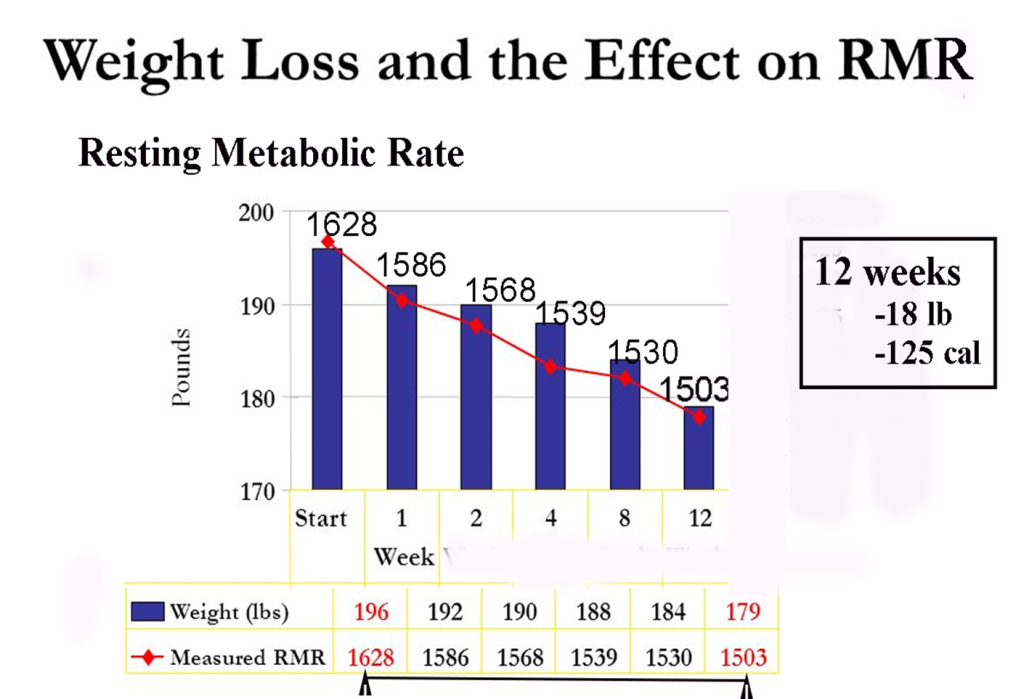
These hormonal and metabolic changes help explain the common observed pattern of early rapid weight loss that plateaus after several months, followed by slow, but progressive weight regain. Different weight loss plans yield different results, but the overall patterns are similar. As people lose more and more weight, they fight a battle that encourages weight regain.
Often, the dieter is unable to recognize this increase in appetite and food consumption because studies have shown that these overeating signals to the brain are below the level of consciousness. Slowly, food portions get larger and selections become higher in calories and carbs. Making recognition of this problem even more difficult is the fact that they happen slowly and relentlessly, often over years.
Although the factors causing weight regain are internal to the body, there are a few external forces that contribute to the battle that results in weight regain.
Weight Regain Due to Environmental Factors and Lack of Physical Activity after Weight Loss
1. External factors responsible for weight regain after weight loss: Often, there is a change in the environment with exposure to high-density, highly caloric foods, which are inexpensive and easy to get. This results in mindless eating, grazing, bingeing, and night eating. The result is the consumption of high-calorie, high-carb foods and snacks, often with no easy control. Ultra-processed foods now contribute to most of the foods eaten in the US. Fewer people prepare meals at home, and more food is eaten in restaurants or takeaways.
2. Limit in physical activity: Occupations have become more sedentary, with more driving and less walking. Taken together, changes in food and physical activity tend to drive people to increase their food intake and decrease their physical activity. The net is weight gain, not weight loss.
The idea that exercising for an hour a day and burning 3500 calories over a week, or reducing food intake by 500 calories a day for a week, will result in a 1-pound weight loss is mistaken. Researchers have shown that this calculation is incorrect because it fails to account for the reduced energy expenditure associated with substantial weight loss.
All of these factors act together to produce weight regain after weight loss. This is observed whether the weight loss is accomplished by simple caloric reduction, by an increase in exercise(graph 1), by anti-obesity weight loss medications, both old and new, and even by the Semaglutides-Ozempic, Wegovy, and Mounjaro (graph 2).
Weight Loss and Regain with Semaglutides and Tirzepatides:
Increasing numbers of patients are turning to semaglutide/tirzepatide medications as an effective treatment for their obesity. Many of these have noted marked weight loss of 20% or more of their starting weight. Additionally, substantial numbers of patients with hypertension, diabetes, hyperlipidemia, and obstructive sleep apnea note improvement or even complete resolution of these conditions with weight loss, even in a few months.
Table 1 below presents the average weight loss and regain observed after stopping various types of therapy including diet and exercise alone, typical anti- obesity therapy with phentermine or Qsymia, therapy and even with the three semaglutides compared to Bariatric surgery:
Table 1 Weight Loss and Regain After Obesity Therapy
| Intensive diet/exercise |
Anti Obesity medication |
Ozempic | Wegovy | Zepbound
Mounjaro |
Bariatric Surgery 1 |
|
| Average weight loss from baseline | 3-8% | 5-10% | 13% | 17% | 21-27% | 25-30% @ 1-2 ys |
| Average weight regain. No meds. |
2-3% | 7% | 11% in 1 yr | 66% in 48 wk |
25-40% |
Dr Lipman’s Protocol for Weight Maintenance using Semaglutide and Tirzepatide Injections ONCE A MONTH:
Once weight-loss goals have been achieved, weight gain can be prevented by slowly tapering medication doses. My experience is that it’s far easier and more effective to reduce the frequency of the injections rather than the dosing.
Here is Dr. Lipman’s weight maintenance protocol once the goal is reached:
After two months of biweekly injections, reduce the frequency to once a month. I have found it simpler to take the injection on the first of each month. On first glance, this sounds like it wouldn’t work; however, the dose to maintain weight is much lower than the one to lose! It has worked for hundreds of my patients over the past two years!
Key Takeaway: Monthly/Semaglutide/Tirzepatide injections can prevent weight regain by minimizing hormonal and metabolic triggers that occur after significant weight loss.
Table 2: shows how the once-monthly maintenance plan may look superimposed on a calendar:
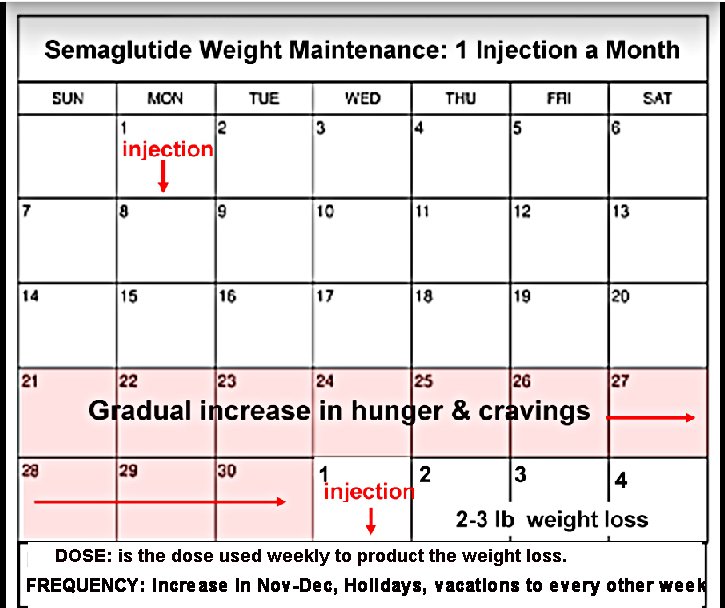
Table 2: Monthly Maintenance Weight Loss With GLP-1’s