

8 Health Benefits of GLP‑1 Drugs Beyond Weight Loss in Miami
by Dr. Richard Lipman, M.D.,
Board Certified Internal Medicine-Endocrinology
reviewed on March 16, 2026
GLP‑1 drugs like semaglutide (Ozempic®, Wegovy®) and tirzepatide (Mounjaro®, Zepbound®) are most famous for their game‑changing weight‑loss effects and effects on blood glucose control in diabetics. However, doctors and researchers are now discovering that the benefits of these injections go far beyond pounds and inches. Even neuro-psychological problems, such as the recently described reduction in food noises. It turns out that GLP‑1 medications impact many of the body’s major systems, and they may protect against chronic inflammation, heart and liver disease, addiction, and even mental decline. Here’s a closer look at lesser‑known benefits of GLP‑1 drugs.
1. GLP-1 Drugs Reduce Cardiovascular Events
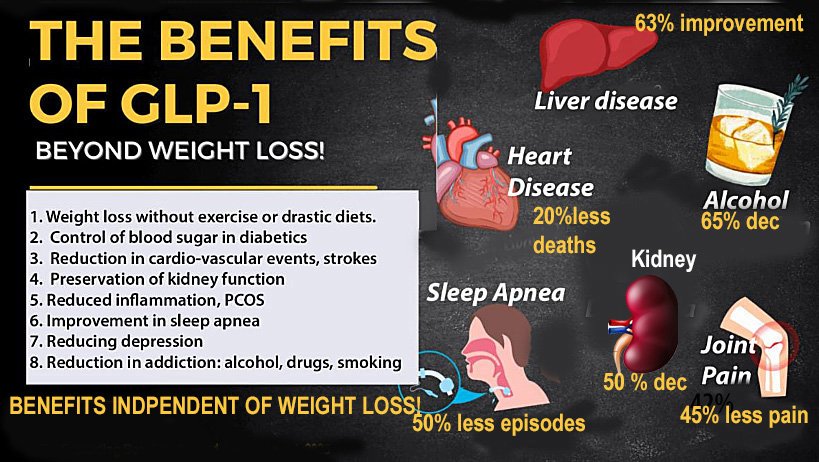
Weight loss and lowering of blood sugar are well-documented effects of these drugs. Beyond these effects is a marked reduction in cardiovascular adverse events, including strokes, heart failure, myocardial infarction (heart attacks), peripheral artery disease, and cardiovascular deaths in diabetics and non-diabetics. In 2024, the FDA approved semaglutide as the first weight-loss medication to reduce the risk of cardiovascular events in adults with obesity with or without diabetes.
Most Recent Evidence of Cardioprotection of GLP-1 Drugs
Recently, in the prestigious British journal The Lancet, a 20% reduction in cardiovascular events was reported among 17,600 non-diabetic subjects who had a BMI of 27 or more and a history of heart disease across 804 medical centers in 41 countries worldwide. Most surprisingly, this effect was independent of the extent of the weight loss. In fact, many subjects experienced this benefit within the first month of starting semaglutide, even at low doses, proving that the weight loss itself was not the cause of this improvement. In addition, semaglutide resulted in a 1% decrease in all-cause mortality, independent of the extent of the weight loss.
More specifically, for every 11 lbs lost( or 2 inches of reduction in waist circumference) there was a 4% reduction in cardiovascular risk. This has led to the approval of the semaglutide, Wegovy, and recently the oral medication, Rybelsus, for cardiovascular protection in overweight or obese individuals.
GLP-1’s Cardiovascular Benefits Independent of Weight Loss
In the Lancet study, the team found that the reduction in major adverse events was similar across participants’ weights at the start of the trial. That is, people only marginally classed as overweight, with a body mass index (BMI) of 27 (the average BMI for adults in the US is 29.4!), saw similar benefits as those with obesity who had the highest BMIs.
The benefits were also largely independent of how much weight people lost in the first four and a half months of taking the drug. However, the researchers found a link between shrinking waistlines (reduction in waist circumference) and heart benefits, accounting for a third of the drug’s protective effect on the heart after 2 years.
Mechanisms of Cardio-Vascular Benefits of GLP-1’s and Value of the Lancet Study
The mechanisms by which GLP-1’s may help cardiovascular health, the researchers said, include supporting the health of the lining of blood vessels, reducing inflammation, improving blood pressure control, and lowering lipid levels (cholesterol and other fats in the bloodstream). The strength of the findings in this report is enhanced due to the scale and duration of the study including 21 expert authors, the 800 centers, 17,000 subjects and the duration of 2 years,
2. GLP-1 Drugs Slow Down Progression of Chronic Kidney Disease
Researchers examined long-term kidney outcomes with GLP-1 receptor agonist use compared with insulin in 11,634 patients treated with GLP-1 receptor agonists and 22,598 patients treated with insulin. The average follow-up was 22 months, and the composite kidney outcome showed a smaller decline in eGFR (glomerular filtration rate) at all time points after 12 months. In addition, there was a lower increase in albuminuria (loss of protein in the urine) in GLP-1 individuals compared to those who only took insulin. Recently updated guidelines for those with diabetes and kidney disease recommend using GLP-1 receptor agonists for those who have not achieved individualized glycemic targets despite metformin and/or insulin.
3. GLP‑1 Drugs Provide Anti‑Inflammatory Protection
Systemic inflammation is one of the most common effects of chronic obesity. Many of the metabolic and cardiovascular risks of being overweight come from this persistent inflammatory state. The metabolic and cardiovascular risks of being overweight come from this persistent inflammatory state. A wide range of studies now show that GLP‑1 receptor agonists can lower inflammatory markers, such as C‑reactive protein (CRP), IL‑6, TNF‑alpha, and others, which have been linked to cardiovascular and metabolic disease risk. In this way, GLP‑1 medications may help reduce oxidative stress and restore the immune system’s balance, improving endothelial function and potentially preventing heart attacks and strokes independently of weight loss.
4. GLP‑1 Drugs for the Brain: Dementia and Alzheimer’s Disease
Brain degenerative effects come from the cumulative inflammatory and oxidative stress often associated with long-standing obesity. This may eventually lead to dementia. Doctors are just starting to realize that GLP‑1 drugs may help protect the brain from the cumulative inflammatory and oxidative stress that ultimately leads to dementia. In animal models of Alzheimer’s disease, as well as in small human trials, GLP‑1 agonists lower amyloid plaque buildup and protect nerve cell function while also improving memory and cognitive performance in tests. Based on these early results, many researchers now consider GLP‑1 drugs to be a potential new class of “neuroprotective” therapies for slowing down the progression of Alzheimer’s disease and other neurodegenerative diseases.
5. GLP‑1 Drugs Reduce Alcohol, Cigarette, and Substance Cravings
GLP‑1 receptors are present not only in the pancreas but also in the brain’s reward pathways and decision‑making centers. It now appears that stimulating these receptors in the brain, GLP1’s may also reduce cravings for alcohol, nicotine, and high‑fat foods. Preliminary research shows that people on GLP-1 drugs have less desire to drink alcohol and generally overeat or indulge; some have even had success using GLP-1 agonists for alcohol use disorders and nicotine addiction. Findings also include a significant decrease in alcohol liver disease. New clinical trials are now testing GLP‑1 medications in patients with alcohol addiction, which, if successful, could revolutionize how we treat and manage addiction. in addition to food cravings, now called ” Food Noises”.
6. GLP‑1 Drugs for Liver Disease: Heal Fatty Liver and Liver Scarring
Non-alcoholic fatty liver disease (NAFLD) has become the most frequent liver disease worldwide, reaching a global estimated prevalence of 32.4% . Characterized by an excessive deposition of fat into the liver cells, it can be complicated by the development of inflammation and fibrosis, developing into non-alcoholic steatohepatitis (NASH) and liver cirrhosis. GLP‑1 receptor agonists reduce liver disease by helping lower triglycerides and reducing fat buildup in the liver. In this way, GLP1 medications both tirzepatives and semaglutides have shown early promise as a therapy for nonalcoholic fatty liver disease and nonalcoholic steatohepatitis (NASH).
7. GLP‑1 Drugs Support Metabolic and Hormonal Balance
The influence of GLP‑1 drugs goes beyond simply helping the pancreas control blood sugar levels. Many patients on these medications experience significant changes in other hormones involved in appetite regulation, the stress response, energy balance, and metabolism. GLP1 drugs, both Titzepatides and semaglutides suppress glucagon secretion, and potentially affect cortisol production, which could help explain secondary benefits to the adrenals and thyroid. This may explain why many GLP-1 patients experience increased energy, improved mood, and even better sleep while receiving the injections.
8. GLP-1 Drugs Improve Sleep Apnea
Sleep apnea occurs when the airway leading from the back of the throat to the bronchial tubes in the lungs becomes blocked during sleep. This leads to frequent breathing pauses. It is often associated with loud snoring, gasping for air, and daytime fatigue. Sleep apnea affects an estimated 2% to 5% of the US population. Although it can develop in anyone, it is more common among people who are overweight or obese.
FDA Approves Zepbound for Sleep Apnea
Tirzepatide and other GLP-1s help with weight loss, reducing fat accumulation around the neck, and improving sleep apnea symptoms. The results that led to Zepbound’s approval for sleep apnea came from 2 double-blind, placebo-controlled studies involving 469 adults without type 2 diabetes. One study included participants who were using positive airway pressure (PAP), the current standard of care for sleep apnea, while the other enrolled participants who were unable or unwilling to use PAP.
In both studies, participants were randomly assigned to receive either 10 or 15 mg of tirzepatide or a placebo once weekly for 52 weeks. The primary measure of success was the change in the apnea-hypopnea index (AHI), which tracks how many times per hour a person either stops breathing (apnea) or breathes shallowly (hypopnea) during sleep.
After 1 year of treatment, participants receiving tirzepatide vs. placebo showed a statistically significant reduction in the sleep apnea index. Many saw their sleep apnea improve to mild or even remission, along with relief from symptoms such as daytime fatigue. On average, participants lost 18% to 20% of their body weight, a key factor in reducing airway obstruction.
GLP-1 drugs, especially tirzepatide, have marked effects on food noises.
GLP-1 drugs have the effect of stopping cravings and stopping impulsive behavior related to highly palatable foods. This is often called food addiction. A more common term is food noises. After several weeks of therapy, the common response is that the patients are not constantly intruded by noises, suggesting they usually highly palatable food.
Conclusion