
How Much Weight Can I Lose Using Dr. Lipman’s Personalized GLP-1 Weight Loss Plan: Algorithm
by Dr. Richard Lipman M.D. Internal Medicine/Endocrinology
Weight Loss Specialist
March 15th, 2026.
Your GLP-1 Weight Loss Algorithm from Dr. Lipman uses a small set of your personal factors—such as age, sex, starting weight, and GLP-1 medication and specific dose—to estimate how much weight you might expect to lose taking various GLP-1 drugs at different dose levels. One of the most common questions I hear from patients considering GLP-1 medications—such as Semaglutide (Qysmia and Wegovy) and Tirzepatide (Zepbound and Mounjaro)—is simple and very reasonable: “How much weight will I lose per week?”
GLP-1 weight-loss medications, including Semaglutide and Tirzepatide, have transformed obesity treatment by addressing the biology of appetite, satiety, and recurrent intrusive thoughts about food, termed food noises, rather than relying on willpower alone. Large clinical trials and real-world patient data consistently show predictable, dose-dependent weight loss when these medications are used correctly and combined with appropriate nutrition, exercise, and follow-up care. Dr Lipman has developed an algorithm to provide an estimate of the expected weight loss for various GLP-1 medications at different dose levels.
GLP-1-Weight Loss Algorithm provides an estimated average weekly weight-loss range taking weekly injections of Semaglutide or Tirzepatide, based on:
-
Your starting weight: It’s easier to have a large calorie deficit when you start losing weight at a higher weight. This, combined with holding on to more water weight at a higher starting weight, accounts for greater weight loss at the start of a weight-loss program, the higher the starting weight.
-
Sex and age: Gender and age play a minor role in the actual weekly weight loss. Some studies show women and
Older people lose weight slightly more slowly than men and younger individuals. -
The specific GLP-1 medication: There are significant differences in weight loss among the 4 major GLP-1 medications, with greater| weight loss with Mounjaro and Zepbound as compared to Ozempic and Wegovy. Compound preparations also offer significant weight loss.
-
The dose level of GLP-1 affects weight loss, with greater weight loss at higher doses.
- Some of the results are based on Wishnofsky’s Rule from 1958. (see below). He bases the weight loss on the
3500 calorie deficit= 1 lb weight deficit.
These estimates reflect what we typically see in patients who are properly titrated, medically supervised, and adherent to therapy. Individual results may vary, but this tool gives you a realistic starting point for setting expectations and planning your journey.
Use the Calculator below to see your Personalized Weight Loss Estimate on GLP-1 Injections
Click Me
lipman-calclipman-calculator-htmlOPENWIHITEREADY T GIweight
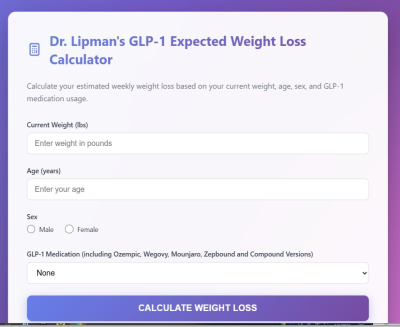
Example of results from this calculator.
Development of Wishnofsky’s Rule
Max Wishnofsky asked in a 1958 report “What is the caloric equivalent of one pound of body weight gained or lost?”1 After a thoughtful analysis of the existing literature, Wishnofsky concluded that “the caloric equivalent of one pound of body weight lost” or “gained will be 3500”. Fifty years later and with thousands of citations in the scientific literature and the lay press, Hill and his colleagues repeated the oft-used statement “an energy deficit of approximately 3500 kcal is needed to lose 1 lb of body weight” i