Weight Regain after Weight Loss: What to Do
Weight regain after weight loss is a common phenomenon influenced by physiological, psychological, and behavioral factors. The body has built-in mechanisms to resist weight loss, stemming from evolution.a. When weight is lost, metabolism slows down—a phenomenon called adaptive thermogenesis—making it harder to maintain a calorie deficit. Hormonal changes also occur; levels of leptin (the hormone that signals fullness) decrease, while ghrelin (the hunger hormone) increases, leading to increased appetite and a drive to eat more. These changes can persist for months or years after weight loss, making weight gain easy. You regain weight after weight loss because dietary changes and exercise are very modest and limited by high relapse rates.
What is Successful Weight Loss?
Drs. Wing and Hill have studied thousands of obese and overweight individuals following a variety of weight loss plans based on diet changes and exercise. They have defined successful weight loss as keeping at least 10% of the body weight off for at least one year. (This definition differs with the FDA, who state that an effective weight loss drug only has to produce a 5% loss above similar placebos in a year.) These and many other researchers find that only 10-20% of overweight individuals are able to obtain the goal of “successful weight loss”. This occurs no matter what diet or exercise plan a person uses.
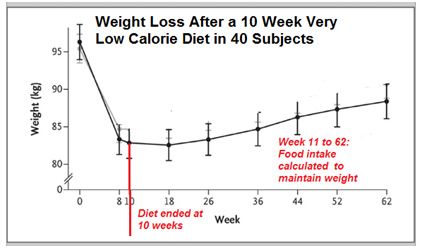
The figure below is adapted from Sumithran, P. et al. from New England Journal Of Medicine (2011:365:1597-1604). It shows people regain weight following 10 weeks of diet and weight loss despite eating calories calculated for weight maintenance.
Hunger Increases After Weight Loss
The reason why 90% of dieters regain their weight within a year isn’t caused by lack of willpower. It is the fact that hunger increases during and after weight loss. These changes continue for several years after, during which time the body tries to regain its lost weight. Studies have shown that this is due to a rise in the levels the hormones and chemicals that cause hunger. These include Grehlin and gastric inhibitor polypeptide.
As illustrated in the graph below, the studies conducted by Dr. Sumithran and colleagues show the changes in hunger perception during and after weight loss. They evaluated hunger before and during a weight loss program and during the maintenance phase by providing a standardized meal and measuring the degree of hunger reported by the subjects over the following six hours.
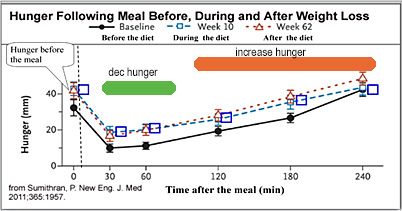
In the graph, the solid black dots illustrate the hunger patterns for four hours after eating a standard meal before the weight loss. Hunger starts off at 32, drops 30 minutes after eating to almost zero, then gradually increases over the next 120 to 240 minutes. It ultimately reaches levels experienced before the meal.
For subjects on their 10th week of the diet, the clear boxes show increased hunger before the meal (as would be expected). This persisted for four hours after the meal. The triangles show an increased hunger pattern before and after a meal when the subject returned to “normal eating” a year after the weight loss. These values are similar to the hunger patterns seen during the dietary phase.
This pattern of increased hunger after completing a weight loss program may be one of the reasons for the common difficulty of maintaining weight loss after most diets, as well as the need for continued treatment after the initial weight loss—either surgical or with medication.