
What Are Net Carbs?
Net carbs are the specific carbohydrates in a food that your body completely digests and converts into glucose for energy. If you’re following a ketogenic diet, this is one of the most important concepts to understand.
Why Net Carbs Matter
Staying in ketosis depends on limiting the carbohydrates your body digests and uses for energy. Fiber is not fully digested and has very little effect on blood sugar. Your body also cannot fully digest or absorb sugar alcohols, so they have a low impact on blood sugar and insulin levels. This is why ketogenic diets typically focus on net carbohydrates rather than total carbohydrates.
This allows you to enjoy many high-fiber vegetables and other nutritious foods that might appear high in carbohydrates at first glance but actually contain relatively few digestible carbs. Most people achieve nutritional ketosis by limiting net carbohydrate intake to approximately 20 to 30 grams per day, although individual needs can vary.
How to Calculate Net Carbs
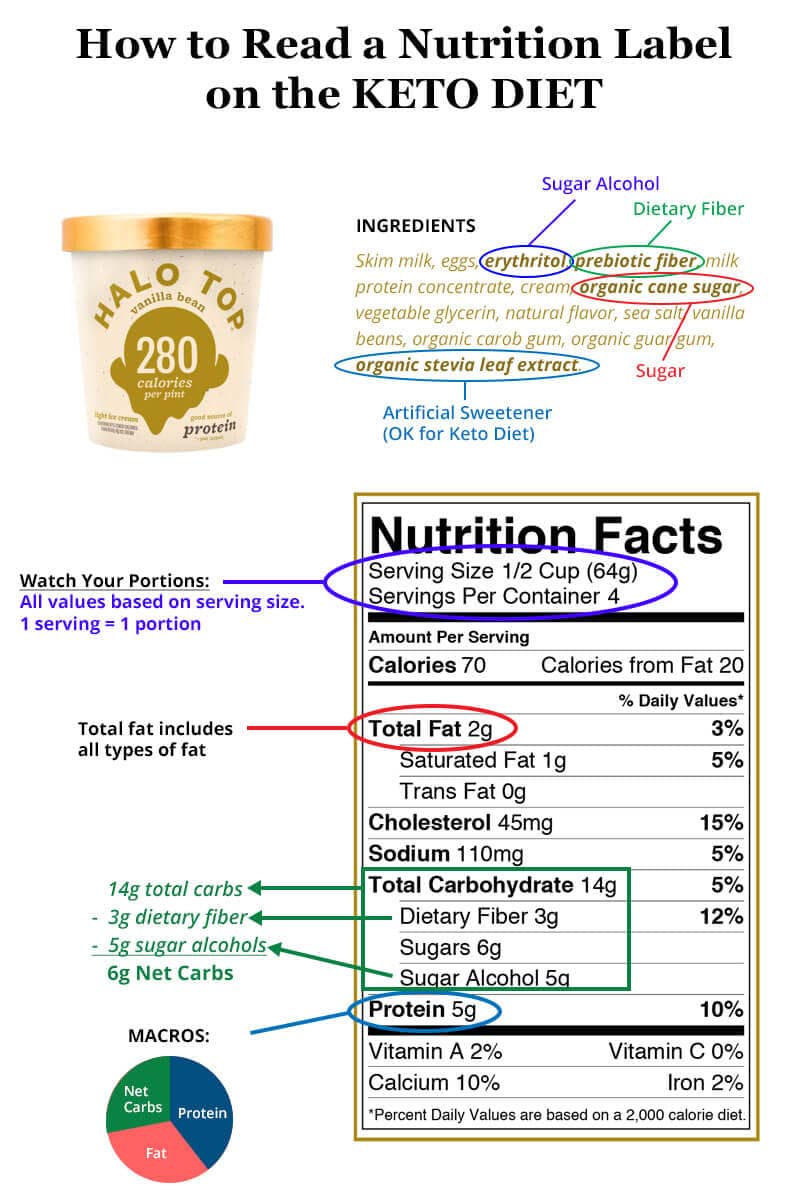
Net carbs are calculated by subtracting dietary fiber and sugar alcohols from the total carbohydrates listed on a product’s Nutrition Facts label.
Net Carbs = Total Carbohydrates − Dietary Fiber – Sugar Alcohols*
For example:
- Total Carbohydrates: 14 grams
- Dietary Fiber: 3 grams
- Sugar Alcohol: 5 grams
- Net Carbohydrates: 6 grams
Thankfully, calculating net carbs only takes a few seconds.
One important detail: always use the serving size listed on the Nutrition Facts label. If you eat multiple servings, you’ll need to multiply the net carbohydrates accordingly. Forgetting to do that is a common mistake among Keto dieters and can easily slow your progress.
What About Sugar Alcohols?
Sugar alcohols are one of the most confusing aspects of calculating net carbohydrates. Some manufacturers subtract certain sugar alcohols when advertising the “net carbs” in their products because they generally have less effect on blood sugar than regular sugar. However, not all sugar alcohols are the same, and some have a greater impact on blood glucose than others.
Here is a table with the breakdown if you want to read the product’s ingredients and get a more specific net carb calculation.
| Sugar Alcohol | Absorption Rate & Impact | How to Calculate |
|---|---|---|
| Erythritol | Has a glycemic index of zero. About 90% is excreted completely unchanged in urine. | Subtract 100% of the grams from total carbs. |
| Mannitol | Very poorly absorbed (about 25%). Most passes to the colon where it ferments rapidly, causing gas. | Subtract 50% of the grams from total carbs. |
| Lactitol | Minimally absorbed in the small intestine. Almost entirely fermented by gut bacteria, often causing mild bloating. | Subtract 50% of the grams from total carbs. |
| Isomalt | Partially absorbed by the body. Digests very slowly and causes minimal glucose release. | Subtract 50% of the grams from total carbs. |
| Sorbitol | Partially absorbed by the body. Can moderately raise blood glucose levels. | Subtract 50% of the grams from total carbs. |
| Xylitol | Partially absorbed (about 50%). Has a minor effect on blood sugar and insulin. | Subtract 50% of the grams from total carbs. |
| Maltitol (Syrup) | Highly absorbed compared to others. Spikes blood glucose similarly to regular sugar. Highly fermentable and can cause bloating. | Do not subtract (treat like regular sugar). |
| Maltitol (Powder) | Partially absorbed. Often spikes blood sugar significantly in diabetics. | Subtract 50% (though subtracting 0% is safer for strict blood sugar control). |
The important thing to remember is that “net carbs” printed on the front of a package is a marketing claim—not part of the Nutrition Facts label.
Common Mistakes When Calculating Net Carbs
Calculating net carbohydrates isn’t difficult, but a few common mistakes can lead to consuming more carbohydrates than you realize.
Trusting the Front of the Package
Terms like “low carb,” “keto-friendly,” and “2 grams of net carbs” are designed to get your attention. They may be accurate, but they don’t tell the whole story. Always turn the package over and verify the Nutrition Facts label. A product may contain multiple servings, additional ingredients, or other details that aren’t obvious from the marketing on the front.
Forgetting That Drinks Count
When calculating your daily carbohydrate intake, remember that beverages count, too.
Many people carefully count the carbohydrates in their meals but overlook what they’re drinking. Sweetened coffee drinks, fruit juice, sports drinks, energy drinks, and some flavored waters can contribute enough carbohydrates to interfere with ketosis.
Assuming Every Keto Product Is a Good Choice
A product can technically fit within your daily carbohydrate allowance and still be highly processed. Keep it simple. Whenever possible, build your ketogenic diet around whole, minimally processed foods such as meat, seafood, eggs, healthy fats, and non-starchy vegetables.
Packaged keto products can be convenient, but they shouldn’t become the foundation of your diet.
Making Keto More Complicated Than It Needs to Be
Some people become so focused on calculating every gram of carbohydrate that they lose sight of the bigger picture. The purpose of tracking net carbs isn’t to make eating stressful. It’s to help you make informed food choices. Once you become familiar with the foods you eat regularly, calculating net carbs becomes much easier and often takes only a few seconds.
From Dr. Lipman’s Practice
Patients sometimes assume that success on a ketogenic diet depends on calculating every gram of carbohydrate perfectly. In my experience, that’s rarely the case.
The patients who tend to do the best are those who build their meals around whole, minimally processed foods and learn a few basic principles, like how to calculate net carbs and pay attention to serving sizes. After a few weeks, they spend far less time reading labels because they already know which foods fit comfortably into their eating plan.
Net carbs are a useful tool, not something you should obsess over.
Common Myths About Net Carbs
Myth: You should count total carbohydrates instead of net carbs.
For most people following a ketogenic diet, net carbohydrates are the more useful measurement because dietary fiber has very little effect on blood sugar.
Myth: Calculating net carbs is difficult.
Not at all. Once you understand the formula, calculating net carbs takes only a few seconds.
Net Carbs = Total Carbohydrates − Dietary Fiber – Sugar Alcohols
Myth: Every food labeled “keto” is automatically low in net carbs.
Not necessarily. Marketing claims can be helpful, but they shouldn’t replace reading the Nutrition Facts label and checking the serving size.
Myth: You have to calculate every gram forever.
No. Most people become familiar with the foods they eat regularly and spend much less time calculating net carbs as they gain experience with the ketogenic diet.
Related Articles
Ready to Simplify Keto?
Learning how to calculate net carbs is one of the most valuable skills you can develop on a ketogenic diet. Once you understand the basics, making keto-friendly food choices becomes much easier.
If you’re looking for a personalized ketogenic diet plan based on your health, medications, and weight-loss goals, Dr. Richard Lipman’s medically supervised Keto Diet Program can help you develop an approach that’s effective, practical, and sustainable.