
Do You Need to Test Your Ketones?
For most people, the answer is no. If you’re following a well-formulated ketogenic diet, losing weight, feeling well, and seeing improvements in your health, routine ketone testing usually isn’t necessary. While measuring ketones can be helpful in certain situations, it isn’t required to achieve success on a ketogenic diet.
That’s because the goal of a ketogenic diet isn’t to produce the highest ketone reading possible. The goal is to lose excess body fat, improve metabolic health, and adopt an eating pattern you can maintain over the long term. Ketone testing is simply a tool, and like any tool, it has situations where it’s useful and others where it adds little value.
When Is Ketone Testing Helpful?
| Situation | Is Ketone Testing Helpful? |
|---|---|
| You’re just starting a ketogenic diet | Sometimes. It can confirm that you’re entering ketosis, but it isn’t required. |
| You’re curious whether you’re in ketosis | Yes. Testing can provide confirmation if you’re interested. |
| You’re losing weight steadily and feeling well | Usually not. Your progress is a better indicator than your ketone level. |
| You’re troubleshooting a weight-loss plateau | Possibly. Testing may help determine whether you’ve drifted out of ketosis, but it’s only one piece of the puzzle. |
| You’re following a therapeutic ketogenic diet for a medical condition | Often yes. Monitoring may be part of your treatment plan under medical supervision. |
| You have diabetes and are concerned about diabetic ketoacidosis (DKA) | Follow your healthcare provider’s recommendations. This is a different situation than nutritional ketosis and may require prompt medical evaluation. |
For most people trying to lose weight, the scale, how your clothes fit, improvements in your energy level, and better overall health are far more meaningful measures of success than ketone numbers alone.
Why Your Body Produces Ketones
Ketones are molecules your liver produces when your body begins using fat instead of carbohydrates as its primary source of energy.
Normally, your body relies on glucose from carbohydrates for fuel. When carbohydrate intake is significantly reduced, your glycogen stores become depleted, insulin levels fall, and your body begins breaking down fat for energy. Some of that fat is converted into ketones, which can be used as an alternative fuel source by many tissues, including the brain.
This metabolic state is known as nutritional ketosis, and it’s one of the primary goals of a well-formulated ketogenic diet. The presence of ketones tells you that your body has shifted toward burning fat for fuel. It doesn’t automatically tell you how much body fat you’re losing, how healthy your diet is, or whether you’re making good long-term progress.
That’s an important distinction: Ketones are a marker that your metabolism has changed, not a score that measures the success of your diet.
Nutritional Ketosis Is NOT Diabetic Ketoacidosis
If you’ve searched online for information about ketones, you’ve probably come across articles discussing >diabetic ketoacidosis (DKA). It’s important to understand that nutritional ketosis and diabetic ketoacidosis are completely different conditions.
Nutritional ketosis: A normal metabolic response to carbohydrate restriction. It’s an expected part of a ketogenic diet and, for most healthy individuals, is considered safe.
Diabetic ketoacidosis: A serious medical emergency. It occurs most commonly in people with type 1 diabetes, although it can also occur in people with type 2 diabetes under certain circumstances, including severe illness or while taking some diabetes medications. Without enough insulin, blood glucose and ketone levels rise to dangerous levels, causing the blood to become acidic. DKA requires immediate medical treatment.
Being in nutritional ketosis does not mean you’re developing diabetic ketoacidosis.
Although both conditions involve ketones, they have different causes, different ketone levels, and very different clinical significance.
What If I Have Diabetes?
If you have diabetes, you also shouldn’t assume that the presence of ketones means you’re developing diabetic ketoacidosis. The difference depends on the overall clinical picture, including your blood sugar, symptoms, ketone levels, and insulin status.
If you have type 1 diabetes, or type 2 diabetes treated with insulin or certain medications such as SGLT2 inhibitors, it’s critical that you talk with your healthcare provider before starting a ketogenic diet. Your medications may need to be adjusted, and you’ll need to understand when ketone testing is appropriate and when it may indicate a medical emergency.
A Higher Ketone Reading Doesn’t Necessarily Mean More Weight Loss
A very common misconception about the Keto diet is that higher ketone levels automatically mean you’re burning more body fat. Unfortunately, it isn’t that simple. Ketone levels tell you that your body is producing ketones, but they don’t measure how much body fat you’re losing. A person with relatively modest ketone levels may lose weight very successfully, while someone with higher ketone readings may see little or no progress if they’re consistently consuming more calories than they burn.
This is one reason I encourage patients not to become overly focused on the numbers. Weight loss depends on many factors, including your overall calorie intake, physical activity, metabolic health, medications, sleep, stress, and long-term consistency. Ketone levels are only one small piece of that picture.
If You Decide to Test, Which Method Should You Use?
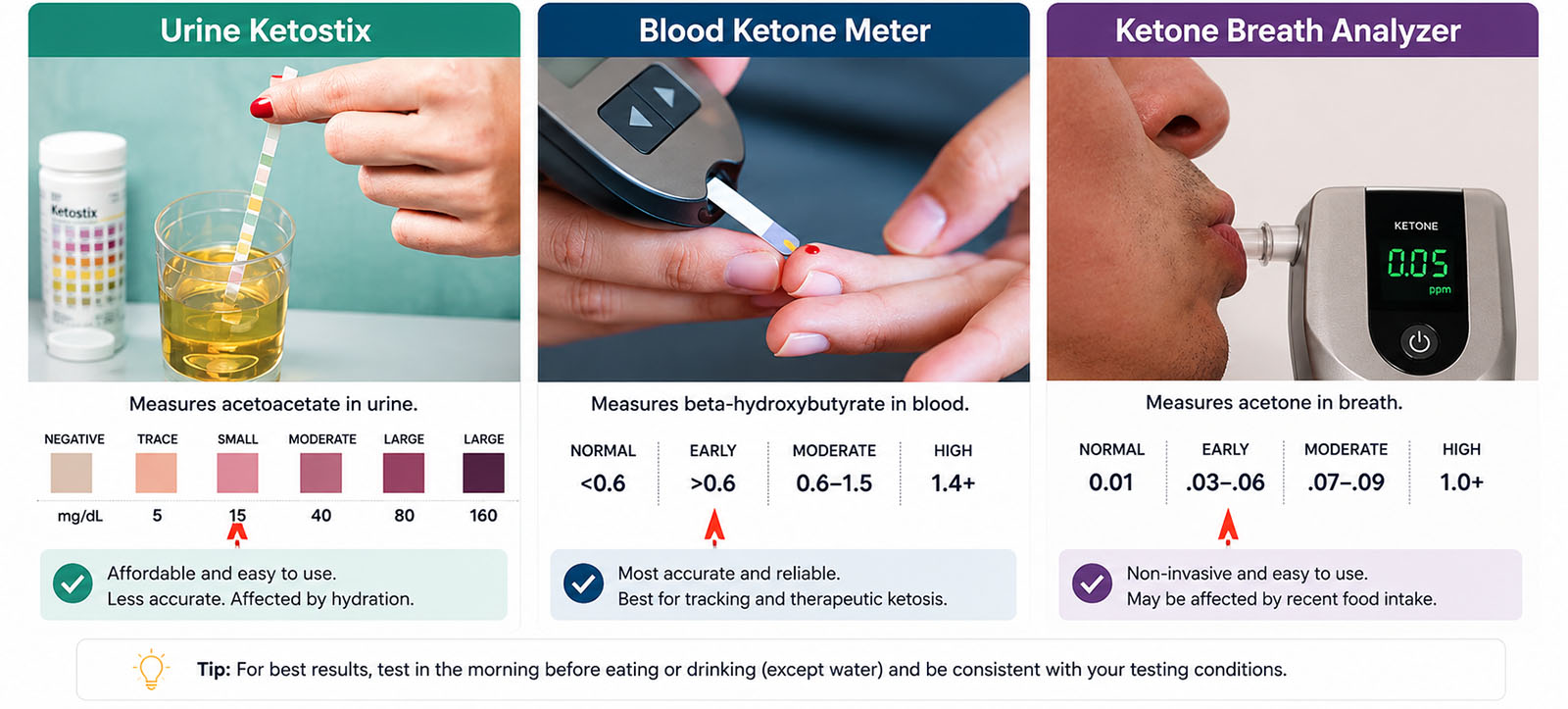
If you’re interested in confirming that you’ve entered ketosis, there are three common ways to measure ketones. Each has advantages and limitations.
Urine Ketone Test Strips
Urine test strips are inexpensive, widely available, and easy to use. They measure ketones that are being excreted in your urine. They’re often helpful during the first few weeks of a ketogenic diet because they can confirm that your body has begun producing ketones. However, as your body becomes more efficient at using ketones for energy, urine strips often become less reliable. A lower reading doesn’t necessarily mean you’ve fallen out of ketosis.
For many beginners, urine strips are a reasonable place to start.
Blood Ketone Meters
Blood ketone meters measure the level of beta-hydroxybutyrate (BHB), the primary ketone circulating in your bloodstream. They provide the most accurate assessment of nutritional ketosis and are commonly used in research studies and therapeutic ketogenic diets. The downside is cost. In addition to purchasing the meter, you’ll need test strips, which can become expensive if you’re testing frequently.
For most people following keto for weight loss, routine blood testing isn’t necessary.
Breath Ketone Analyzers
Breath analyzers estimate ketone production by measuring acetone in your breath. Because they don’t require finger sticks or disposable strips, they’re convenient for people who prefer a reusable testing method. However, the accuracy of breath analyzers varies among devices, and the readings don’t always correlate well with blood ketone levels.
For that reason, I generally consider them a convenience tool rather than the gold standard for measuring ketosis.
Comparing the Three Methods
| Method | Accuracy | Cost | Best For |
|---|---|---|---|
| Urine Test Strips | Moderate (especially early in keto) | Low | Beginners who want to confirm they’re producing ketones |
| Blood Ketone Meter | High | Higher | The most accurate measurement of nutritional ketosis |
| Breath Ketone Analyzer | Variable | Moderate to High | People who prefer a reusable, non-invasive testing method |
From Dr. Lipman’s Practice
Patients sometimes ask whether they should be testing their ketones every day. My answer is usually another question: “How are you doing?”
If you’re following your ketogenic diet, losing weight, feeling better, and your health is improving, those are the results that matter most.
I treat patients, not ketone numbers.
I’ve seen patients become discouraged because their ketone reading wasn’t as high as they expected, even though they were steadily losing weight and making excellent progress. I’ve also seen people with impressive ketone readings struggle to lose weight because they were paying more attention to the meter than to their overall eating habits.
Ketone testing can be useful, but it shouldn’t become the goal. The goal is improving your health.
Common Myths About Ketone Testing
Myth: Everyone on a ketogenic diet should test their ketones.
No. Most people can successfully follow a ketogenic diet without ever measuring their ketone levels. Testing is optional for many individuals and is most useful in specific situations.
Myth: Higher ketone levels always mean greater fat loss.
Not necessarily. Ketone levels indicate that your body is producing ketones, but they don’t measure how much body fat you’re losing. Progress should be judged by your overall health, body weight, body composition, and how consistently you’re following your eating plan.
Myth: Urine ketone strips are always accurate.
Urine strips are most useful during the early stages of a ketogenic diet. As your body adapts to using ketones more efficiently, they often become less reliable, even though you’re still in nutritional ketosis.
Myth: If my ketone reading is low, my ketogenic diet isn’t working.
Not necessarily. A single ketone reading provides only a snapshot in time and can be influenced by several factors. If you’re consistently following your ketogenic diet and making progress toward your health goals, a lower ketone reading isn’t usually a reason for concern.
References
- StatPearls – Ketogenic Diet
https://www.ncbi.nlm.nih.gov/books/NBK499830/ - StatPearls – Adult Diabetic Ketoacidosis
https://www.ncbi.nlm.nih.gov/books/NBK560723/ - Standards of Care in Diabetes
https://diabetesjournals.org/care/issue - Hyperglycemic Crises in Adults With Diabetes: A Consensus Report
https://diabetesjournals.org/care/article/47/3/549/153062/Hyperglycemic-Crises-in-Adults-With-Diabetes-A - Hallberg SJ, McKenzie AL, et al.
Effectiveness and Safety of a Novel Care Model for the Management of Type 2 Diabetes at One Year.
https://pmc.ncbi.nlm.nih.gov/articles/PMC6104272/
Ready to Start the Keto Diet?
Ketone testing can be a useful tool, but it’s only one small part of a successful ketogenic diet. Most people achieve excellent results by consistently following a well-formulated eating plan without focusing on ketone numbers.
If you’re considering a ketogenic diet and want a plan that’s tailored to your medical history, medications, and weight-loss goals, Dr. Richard Lipman’s medically supervised Keto Diet Program provides individualized guidance to help you lose weight safely and build healthy habits that last.